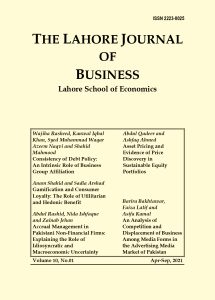
The Lahore Journal
of Business

Lahore Journal of Business

(HEC recognized journal in “Y” category)

The Lahore Journal of Business is aimed at providing a specialized forum for dissemination of qualitative and quantitative research in various areas of business administration. The LJB invites researchers, policy makers and analysts to submit original theoretical and empirical papers that explore and contribute to the understanding of various areas in the business domain. The Journal aims at bringing together state-of-art research findings, particularly from emerging markets, in various business disciplines including (but not limited to) accounting, banking, management, marketing, finance, investments, human resource management and organizational behavior.

Abdul Rafay, Ramla Sadiq and Mobeen Ajmal

IAS-24 of the International Financial Reporting Standards focuses on the concept and disclosures of related party transactions (RPTs) for a reporting entity. This study examines the interrelationship between RPTs (as disclosed under IAS24), agency theory, ownership structures and firm performance. Our sample includes nonfinancial companies indexed by the KSE-100 of the Pakistan Stock Exchange during 2006–15. To run the regression models, we determine the regression assumptions, normality, heteroskedasticity, autocorrelation and multicollinearity. We investigate the impact of different RPTs, including cash inflows and outflows, whereas other studies generally look at the impact of RPTs on firm performance in totality. The empirical analysis suggests that institutional ownership has a positive, significant impact on firm performance. Related party purchases have a significant, negative impact on performance, resulting in the expropriation of institutional ownership. RPTs that generate revenues have a significant, positive impact on performance, such that institutional ownership has a propping-up effect with respect to the related parties. In practice, institutional ownership leads to strong corporate governance and contributes to firm performance. While other studies find family ownership responsible for the expropriation effect, we argue that institutional ownership has a propping-up and expropriation effect on related parties. Our study also suggests that certain ownership structures lead to weaker corporate governance mechanisms, resulting in greater agency problems. This, in turn, badly affects company performance and leads to the exploitation of minority shareholders.

https://nongkiplay.com/ samson88 samson88 samson88 kingbokep jenongplay samson88 dausbet dausbet cagurbet samson88 dausbet slot777 cagurbet slot mpo dausbet cagurbet samson88 dausbet https://www.chabad.com/videos/ cagurbet bintang4d samson88 karinbet cagurbet samson88 samson88 karinbet samson88 samson88 samson88 samson88 dausbet cagurbet dausbet cagurbet samson88 karinbet cagurbet dausbet cariwd88 samson88 cagurbet jamur4d cariwd88 basarnasbogor.com cagurbet cariwd88 dausbet samson88 samson88 samson88 karinbet samson88 cagurbet karinbet karinbet cariwd88 dausbet cagurbet surga 898 lobi89 lobi89 akun pro thailand cagurbet cagurbet samson88 cariwd88 cariwd88 cariwd88 cagurbet cariwd88 cariwd88 apk slot cagurbet samson88 slot terpercaya situs slot apk slot APK SLOT slot thailand bolang 588 cariwd88 cagurbet cagurbet samson88 cagurbet cagurbet cagurbet dausbet dausbet samson88 cariwd88 cagurbet cariwd88 cariwd88 cagurbet samson88 samson88 cariwd88 dausbet cagurbet macan238 cariwd88 samson88 cariwd88 samson88 apk slot apk slot omo777 dausbet samson88 cariwd88 cagurbet dausbet samson88 samson88 cagurbet cariwd88 samson88 cagurbet dausbet samson88 samson88 cagurbet cagurbet cagurbet samson88 cariwd88